 Mrs. Foster's Third Grade (email)
Alvin Elementary School
Santa Maria, California
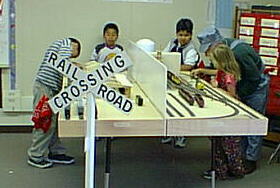
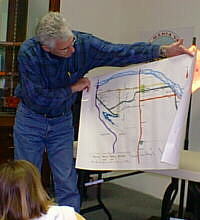
Generally speaking, railroading time in the classroom for 2002 was from 1:40pm to 2:33pm (the last "period" of their school day) on days that included railroad time. In 2003, it was from 1:00pm to 1:50pm. The HO layout work was conducted as a "center" by the classroom teacher's husband and/or father-in-law. They typically worked with 4 to 8 students at a time while the rest of the class was working on other things (which may or may not have been related to the railroading/history project, depending on the teacher's overall plans). For a chronological view of the activities, see the schedule: 2002, 2003.
In addition to "railroad time" activities, other regular classroom activities included railroad/history thematic material when appropriate: reading, vocabulary, language, etc.
Clearly, this project depended heavily on work by two railroading fanatics, a husband (email) and a father-in-law, and on occasional support from other family members and parents (e.g. field trip chaperones, classroom help, etc.).
Here's a list of the activities in the classroom by subject area:
Art
- Design the logo (allow 8-12 weeks if you intend to have patches produced)
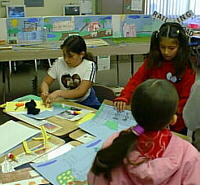
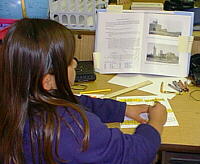
- 3-D drawings of historical buildings (pictured at right)
- Timeline images: events were marked on the classroom timeline by short descriptions and pictures written by and drawn by the students. The timeline went most of the way around the classroom near the ceiling and ranged from the 1700s to the present.
- Modeling of ground and structures on the HO Layout
- Drawings for the Thank You Notes for the 3 field trips (example)
- Illustrations for their short story and for their final report.
History
- Physical evidence
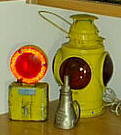
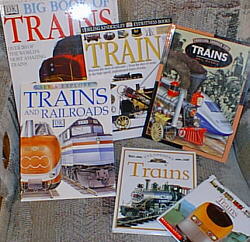
- Railroad realia from the Foster collection brought to the classroom. Items were discussed and then labeled by the students.
- Artifacts at the two museums visited (railroad, historical)
- Timeline: around the classroom near the ceiling
- Presentations:
- History of the Santa Maria Valley and the City
- Overview of Railroading in the U.S.
- History of the Santa Maria Valley railroads (several sessions)
- Video: Sugar Beet Trains (Video Rails #VR074)
- Early settlement of the area (Foxen, Miller, Cook, Blosser, Thornburg, etc.)
- Conservation: every part of the sugar beet is used, either for sugar or for cattle feed
Geography
- Relative Location: maps, HO layout, compass directions
- Place characterization: farming, oil, coastal
- Historical movement (Chumash - Settlers - Cities, California Mission trail)
Economics
- Farming: sugar beets, cattle, produce
- Natural resources: oil
- Transportation: railroads (major element and umbrella theme for the project)
Culture
- Chumash
- Early Settlers
- Early churches, schools, mercantiles of Santa Maria
Reading and Writing
- Timeline event descriptions
- Short Stories. Using the unit's vocabulary, students wrote a short story including illustrations.
- Final Report. Topics chosen include: the railroads of the valley, the Chumash, train signals, the first school, fire!, Hart House, steam locomotives, Capt. Hancock, the high school, sugar beets, and mule/horse teams.
- Vocabulary [Word97, 28Kb]. Activities/homework using these words included using them in sentences, crossword puzzles, etc.
- Classroom Library
- Thank You Notes for the 3 field trips (example)
Study Skills
Visual Learning
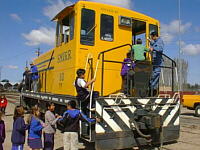
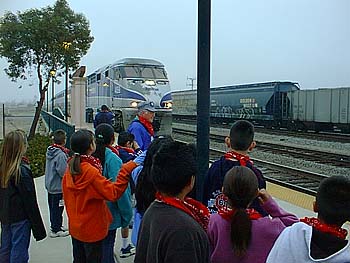
- Observation: field trips (railroad, railroad museum, historical museum, Amtrak trip), books, photos
- Timelines
- Chart: link dates, page numbers (of photos), events
- Interpretation: photos, pictures, illustrations, artifacts all over the classroom
- Symbols: railroad operations
- Visual self-expression: drawings, reports, and other class activities
Map and Globe Skills
- Read a map, symbols, keys, etc.
- Location, coordinates
- Follow routes
- Scale (the HO train layout is 1:87) and distance
- Construction and use: a 3-D HO layout, layout diagram
Critical Thinking
- Evaluate and judge: search for and report on main ideas
- Solve and conclude: cause and effect (train operations, among others)
Other
[Home]
[Synopsis]
[Train Layout (HO)]
[Schedule: 2002, 2003]
[For Teachers]
[What's New]
[Site Overview]
|